Offline-First Coding Agent
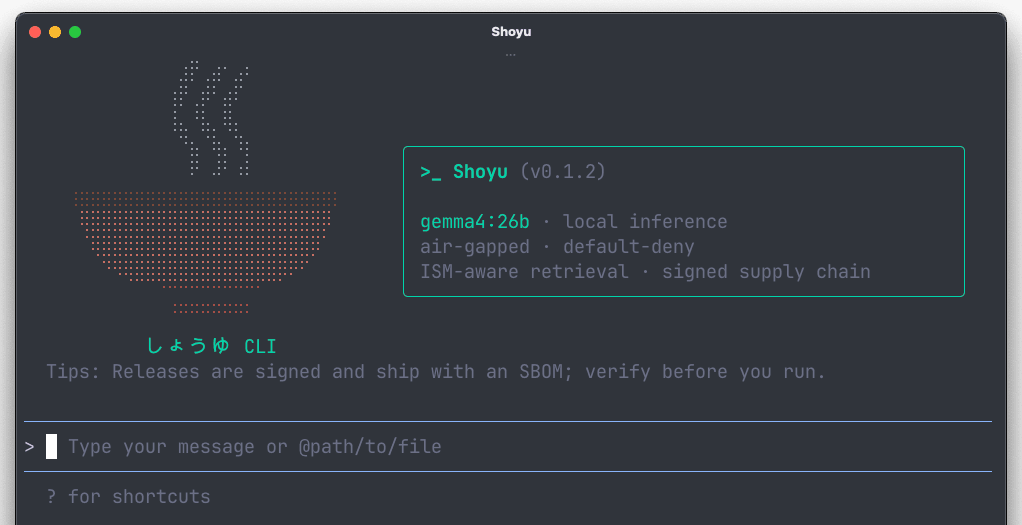
An offline-first terminal AI coding agent, built from scratch to run entirely on local hardware — no cloud, no telemetry, no phone-home — for sovereign, air-gapped, high-assurance environments where hosted assistants simply cannot go.
What it is
This is a terminal AI coding agent built around one hard rule: it never leaves the machine. No cloud APIs, no telemetry, no phone-home. It runs against a local model server — Ollama by default, or anything OpenAI-compatible — and provides the full agentic loop: read and edit files, run shell commands, search a codebase, hold persistent memory, spawn sub-agents. The assistant you reach for somewhere the cloud is simply not an option.
Built offline-first, from the ground up
This is not a cloud tool with the network switched off. It was built from scratch to be offline — the architecture assumes no internet exists, and every part of it, from the agent loop to the permission model, is designed around that constraint rather than retrofitted to it.
The hard part is making an agent reliable on the small local models that air-gapped hardware can actually run. A 14–26B model is far less forgiving than a frontier endpoint — tool schemas have to be lean, prompts tight, and the loop disciplined, or the model loses the thread. A lot of the real work lives in exactly that unglamorous place.
Designed for high-assurance environments
The offline-first posture is the whole game in air-gapped, sovereign, high-assurance settings — the regulated, government-adjacent networks where hosted coding assistants are non-starters precisely because they reach out to the internet. The design leans into what those environments actually demand:
- Default-deny, not default-allow. Every action is refused unless explicitly permitted — the inverse of how consumer agents behave, and the only defensible posture when the blast radius is real.
- Provenance you can attest. Signed releases and a software bill of materials, so a tool dropped onto an air-gapped workstation can prove where every byte came from.
- A compliance-aware knowledge base. A local retrieval layer over a curated corpus — including Australia's ASD Information Security Manual — so the assistant can answer "how do I configure this, and which controls does that satisfy?" entirely offline. A corpus no hosted tool can touch.
- An evaluation harness that doubles as proof. Real infrastructure tasks run under a hard network block, which makes the eval suite itself the strongest evidence that it genuinely works with the cable pulled.
Status
Working code with receipts — including a negative one, kept on purpose. The agent runs a 41-test suite and a 14-case eval harness on Apple-silicon hardware; the harness's most useful result so far is that the agent (78.6%) lost to the raw model it wraps (92.9%) on single-turn generation — which convicted the eval, not the tool: single-turn tasks never exercise the agent loop. The suite is being rebuilt around multi-turn infrastructure tasks, with agency's measured overhead at ~15% wall-clock.
Beneath it, a reproducible serving benchmark (July 2026) settles the local-inference stack with numbers — mlx-lm sustains 187 tok/s at 8-way concurrency where vllm-mlx degrades to 91 — and a working LoRA fine-tune (loss 5.2 → 0.05, a 5.6 MB adapter) proves the local-training path. The same harness re-runs unchanged on bigger hardware.