AI Claim-Provenance Engine
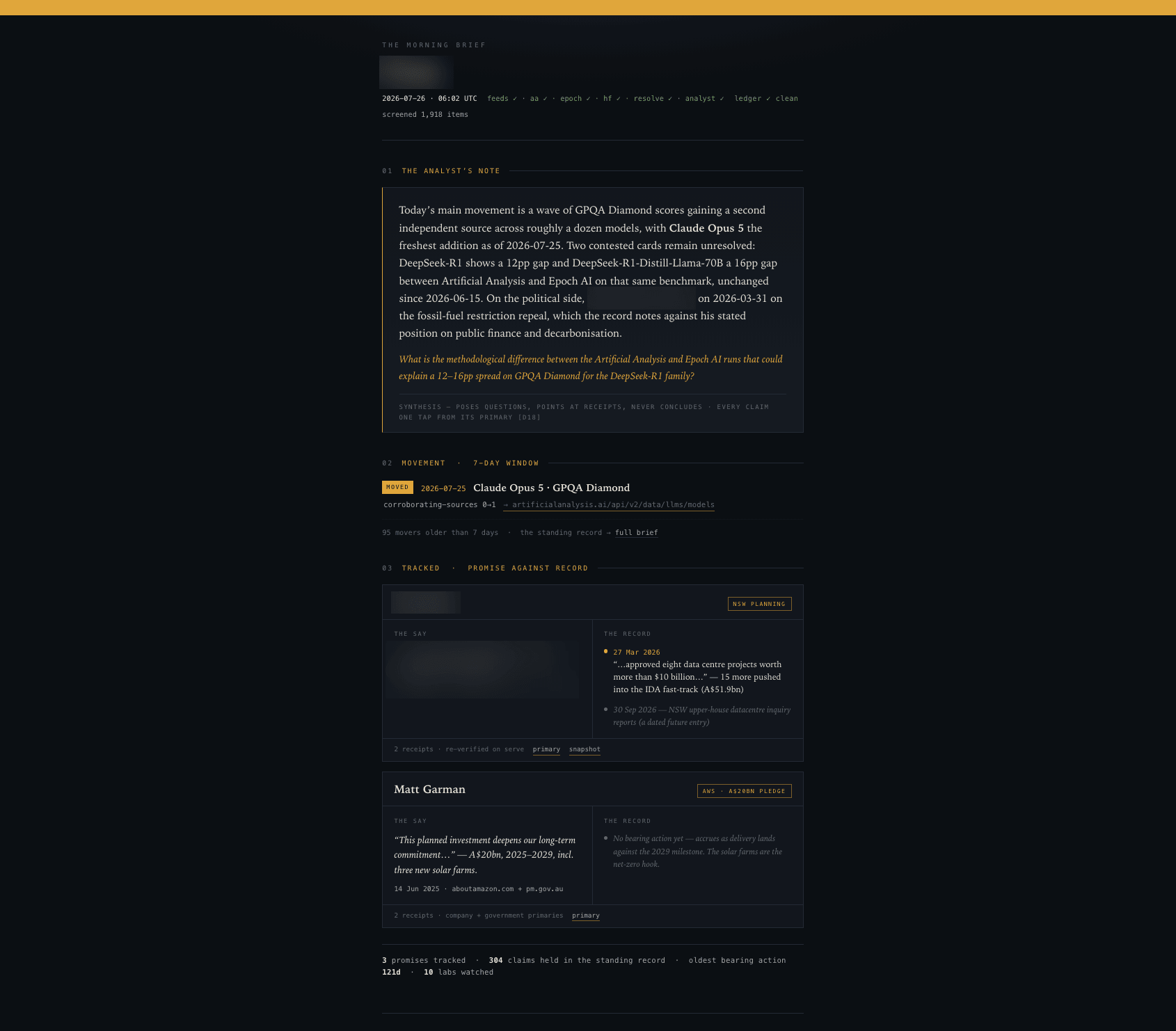
A provenance engine for the claim stream — AI model releases, benchmark scores, vendor metrics, and now public commitments — extracted into a ledger of claims, each tiered by source reliability and pinned to a hash-verified snapshot. It renders a brief that points at receipts and never adjudicates: a claim with no re-verifiable snapshot does not render.
What it is
The AI industry ships claims faster than anyone can check them — a model beats a benchmark, a vendor leads a category, a score appears with no referee. This is a pipeline that treats each of those as a claim to be pinned to its source, not believed. It ingests the model-news stream and the independent-eval feeds, extracts every assertion into a subject–predicate–object triple, tiers it by how reliable the source is and how many others corroborate it, and stores the raw source as a hash-verified snapshot. The output is a brief of claim-cards — the claim, its source rating, whether it was scored on an independent benchmark or self-reported, and a one-tap pointer to the receipt. It tells you who said it and what backs it.
The same machinery now watches a second stream: commitments. A public promise is minted into the ledger with each restatement filed as evidence of the commitment, and later actions linked back to it through typed, fail-closed links. The card shows what was promised, who kept saying it, and what has actually happened since — folded for balance, no tally, no verdict. Promise → outcome, as data.
The invariants are the product
Each rule is enforced on the serve path, not promised in a README:
- Never adjudicate. No truth labels, no verified / debunked verdicts. A card serves the claim triple, the source rating, and the verifiability class — independently benchmarked versus vendor-administered — as raw data. Corroboration raises a claim's visibility; it never blesses it.
- Receipts re-verify on read. Every source is snapshotted and re-hashed on read. A snapshot that is absent or tampered fails integrity and its evidence line is dropped — and a claim left with no verified receipt does not render at all. Provenance is checked at serve time, not asserted once at write time.
- Grounded or rejected. A claim the model proposes but cannot ground in the source text is refused at the extraction gate. Nothing reaches the ledger on the model's word alone.
- The funnel is logged, not hidden. Every proposed claim that doesn't survive — ungrounded, unresolved, un-snapshotted — is written to a rejection ledger with the exact stage it died at. The pipeline's failures are as inspectable as its output.
- Source tier served raw. Each claim carries an Admiralty rating — the source-reliability grading used in intelligence assessment: a reliability letter times a corroborating-source count — and independent-benchmark claims are structurally distinguished from vendor-administered ones.
- Zero network on serve. The brief renders from the local database and snapshot store only — no third-party request on the path that serves you the page.
- Commitments are minted by a human. The model can propose; only the operator mints a promise into the ledger. What a person said they'll do is too load-bearing to enter the record on a model's word.
How it's built
fetch → snapshot → extract → resolve → store → render, every stage real code. A self-hosted LLM gateway does the extraction; everything downstream is deterministic. Ingest sources are hostile-by-default, so TLS on that path is non-negotiable — the only override is a custom CA bundle, never an off switch. It runs unattended in-cluster on a schedule, lays a dated brief onto a persistent volume, and re-verifies every receipt against the snapshot store on the way out. 638 tests gate the merge (July 2026).
Status
The use gate was convened early — the first morning produced the dispositive finding (a 928-line pager dump is a ledger, not a briefing) — and the next phase earned its ratification. The digest now folds that ledger into fifteen movement-gated lines, briefs render byte-identical when nothing has moved, and the system drafts a morning analyst's note — model-written, published only after passing seven deterministic walls; a note that fails a wall does not serve. And a hardened public web surface (zero-JS content-security policy, no database on the serve path, attack-tested against batteries of hostile URLs) is built and running dark. Not exposed yet.